Digital dentistry refers to the use of computer-assisted procedures in diagnostics, planning and treatment – from impressions and X-rays to the manufacture of dental restorations. For you as a patient, this above all means three things: more comfortable treatments, more accurate results and better predictability. In our practice in Berlin-Rudow, we use these procedures where they offer a real advantage – as a complement to personal examination and experience, not as an end in itself.
What does digital dentistry mean for you?
Digital dentistry makes many treatment steps more comfortable, more precise and easier to follow. Instead of traditional impression material, a scan is often enough; images can be viewed together on screen; and dental restorations are planned on the computer.
The benefits at a glance:
- fewer unpleasant moments, for example during impressions
- more accurate foundations for diagnosis and planning
- fewer repeated impressions and therefore often fewer appointments
- findings you can follow on screen
What matters to us: technology does not replace conversation or clinical experience. It provides the data – we make the assessment and decision together with you. The following sections show where we use the individual procedures in practice and what they offer you.
Digital impressions with the intraoral scanner
The intraoral scanner is a small camera with which we capture your teeth three-dimensionally in just a few minutes – without an impression using moulding material. As we move the scanner along the teeth, an accurate model of your dentition gradually appears on screen.
For many people, this is the most comfortable part of digital dentistry. The filled impression tray is eliminated, as is waiting for the material to set. Especially with a sensitive gag reflex, this makes a noticeable difference – the scan can be paused briefly at any time and then continued.
Beyond comfort, digital impressions have practical advantages:
- Accuracy: The digital model depicts the teeth very precisely, which improves the fit of crowns, bridges or splints.
- Reusability: The data can be used directly for planning restorations or splints without intermediate steps via a plaster model.
- Comparison over time: Previous scans can be used, for example to observe changes at the gum line.
- Clarity: You see your dentition directly on screen and can review findings together with us.
The scanner is used, among other things, for crowns and bridges, splints for teeth grinding and in orthodontics. For children or anxious patients, the low-contact approach is often a relief.
Three-dimensional diagnostics with CBCT
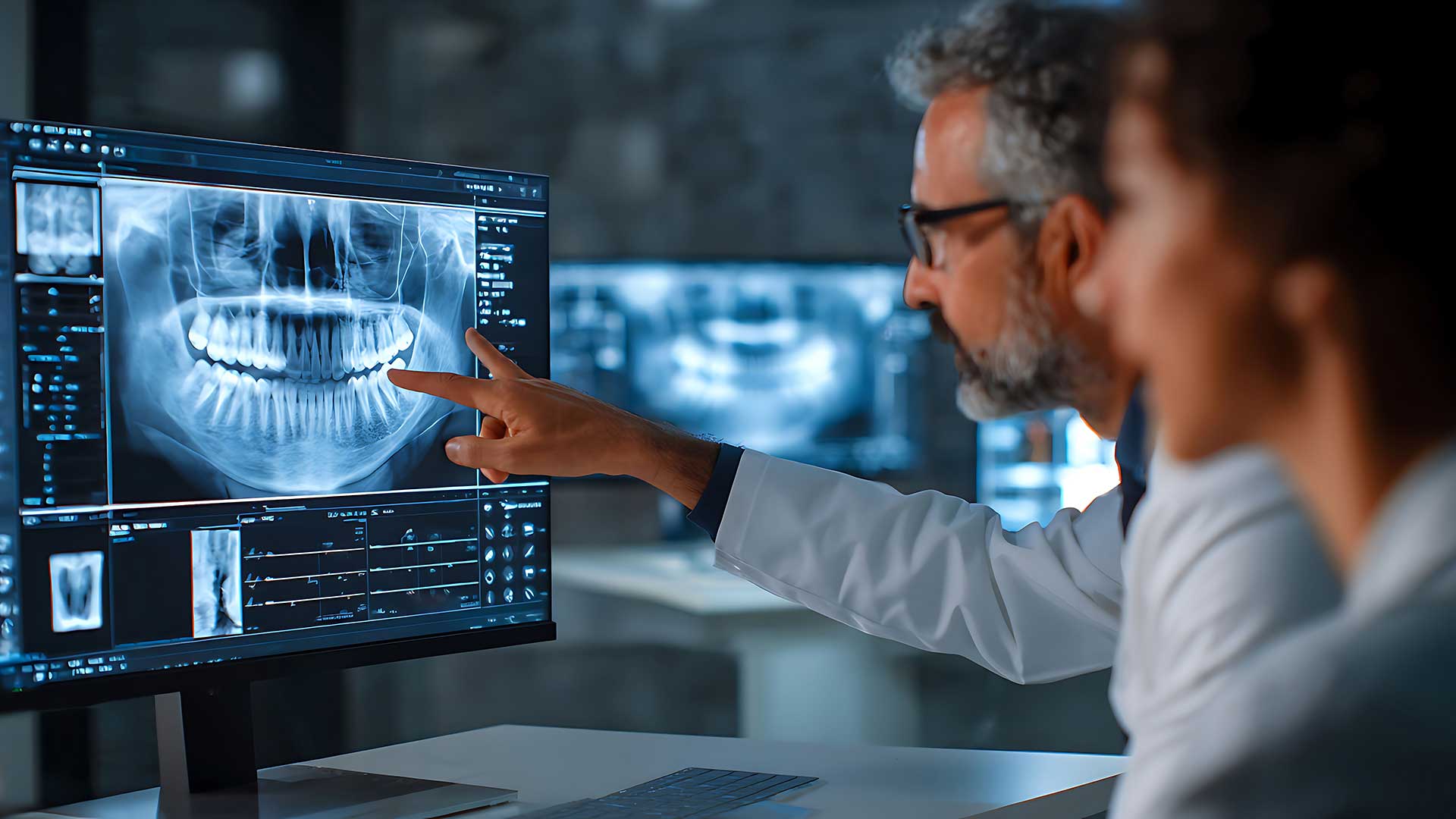
CBCT (cone beam computed tomography) is a special X-ray that displays the jaw three-dimensionally. Unlike a normal flat X-ray, it shows bone, teeth, nerve canals and the maxillary sinus spatially and from all directions.
This spatial view is decisive in certain situations. Before placing an implant, it can be used to assess how much bone is available in height and width, where important nerves run and whether bone augmentation or a sinus lift is necessary. The implant position can thus be planned precisely before the procedure – making treatment safer and more predictable.
Typical areas of use include:
- implant planning – assessment of bone availability and nerve course
- removal of impacted wisdom teeth lying close to a nerve
- clarification of cysts, inflammatory processes or unclear findings
- difficult root canal treatments with branched canals
As valuable as this information is, honesty also requires saying: CBCT involves a higher radiation dose than a single dental X-ray. We therefore only create it when spatial information is genuinely necessary for your treatment, not routinely. Where a conventional image is sufficient, we stick with that.
Digital functional analysis
Digital functional analysis records how your lower jaw moves and how the teeth meet when chewing and closing. Teeth, chewing muscles and jaw joints form an interconnected system – if one part does not fit, this can cause symptoms.
During analysis, jaw movements are recorded and evaluated on the computer. Unlike a mere snapshot, this creates a picture of how your bite actually works in everyday life. This data flows into the design of restorations or splints so that they not only fit but also feel natural and do not overload the jaw.
Functional analysis is particularly helpful in these cases:
- Extensive dental restorations: When several teeth or entire jaw sections are restored, a harmonious bite is especially important.
- Jaw joint problems: Clicking, pain or limited mouth opening may be related to jaw function.
- Teeth grinding: Those who grind at night stress teeth and joints; a precisely fitted splint can provide targeted relief.
The goal is always the same: a restoration that fits into your natural movement pattern – not the other way around. Subsequent adjustments can often be reduced as a result.
Dental restorations from the CAD/CAM process
CAD/CAM stands for computer-aided design (CAD) and manufacture (CAM) of dental restorations. Based on the digital scan, your crown, inlay or bridge is constructed on the computer and then precisely milled from a material block.
The process consists of three steps:
- Scanning: The intraoral scanner captures the prepared teeth three-dimensionally.
- Planning: The shape of the restoration is constructed on the computer – precisely matched to the neighbouring tooth and opposing bite.
- Manufacturing: A milling machine produces the restoration from a ceramic block.
Full ceramic is often used for the restoration – a biocompatible, tooth-coloured material that blends well with natural teeth. The digital route ensures a very accurate fit at the transition to your own tooth, which is important for durability and gum health.
For you, the process above all means: a precise fit, a natural tooth-coloured result and, in many cases, fewer work steps and appointments.
Not every restoration can be made entirely digitally or in a single session – for more complex work, the dental laboratory remains involved. To find out which solution makes sense in your case, see also our article "Dental prosthetics: which option is right for me?".
As a family-run practice, we combine these procedures with long-standing experience – technology supports treatment, but we make decisions together with you.